Join Our Volunteer Elections Team
We're pulling out all the stops to ensure voters get out and vote for reproductive freedom candidates up and down the ballot, and we want you with us!
Formerly NARAL Pro-Choice America
We advocate for our right to abortion, birth control, paid parental leave, protection from pregnancy discrimination, and so much more.
We're pulling out all the stops to ensure voters get out and vote for reproductive freedom candidates up and down the ballot, and we want you with us!
Equip yourself with the facts. Here you’ll find explainers, deep dives, and other resources on reproductive freedom.
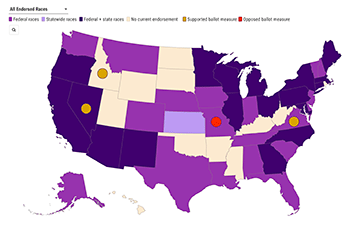
The key races we're invested in between now and November 3 to win back a reproductive freedom majority in the 2026 midterms.
Our electoral efforts connect voters with opportunities to make tangible change to help build a future where everyone is free to make their own decisions about their bodies, lives, and families.
We elect reproductive freedom champions from statehouses to the White House and protect and expand abortion rights and access through ballot measures.
Under a second Trump presidency, attacks on reproductive freedom have been relentless. But we’re tracking and fighting back against this extremist anti-abortion agenda.

Project 2025 is no longer just a “plan,” it’s a checklist of extreme policies being implemented at an alarming pace.
Mobilize your community. Hold lawmakers accountable. Organize for reproductive freedom!
Help turn values into votes by mobilizing voters and electing reproductive freedom champions up and down the ballot.
Memos & Media Guidance
TO: Interested Parties
FROM: Reproductive Freedom for All
RE: Black Maternal Health Week 2026: Abortion Bans, Medicaid Cuts, and the Growing Toll of Anti-Abortion Extremism
DATE: Thursday, April 16, 2026
MEMO: Black Maternal Health Week 2026: Abortion Bans, Medicaid Cuts, and the Growing Toll of Anti-Abortion Extremism
Black women in the United States are over three times more likely to die from pregnancy-related causes than white women. That gap has widened since the Dobbs decision, as abortion bans have forced delays in emergency care, driven providers out of states and exacerbated health care deserts, and stripped pregnant patients of the right to make basic medical decisions. The communities impacted are disproportionately Black.
The consequences of abortion bans and other restrictions on reproductive freedom reach Black people at every stage of pregnancy—from emergency rooms where doctors face criminal penalties for providing care, to courtrooms where judges override patients’ medical decisions, to communities where providers have fled and hospitals have shuttered their doors.
Amber Nicole Thurman was a 28-year-old medical assistant in Georgia who was planning to go to nursing school. She died of sepsis after she couldn’t access legal abortion care in Georgia. The state’s maternal mortality review committee found that her death was preventable.
Porsha Ngumezi, a 35-year-old mother of two, tragically died after a miscarriage at 11 weeks when Texas’s abortion ban deterred doctors from providing the lifesaving procedure she needed. Despite her critical condition and a known blood-clotting disorder, she was given less effective treatment for her symptoms. She continued to hemorrhage until her heart stopped. Medical experts say her death was preventable.
Cherise Doyley—a professional birthing doula—was 12 hours into labor in Jacksonville when a supervisor brought a tablet to her bedside. On the screen, a judge in a black robe was flanked by lawyers, doctors, and hospital staff, most of them white. The state had filed an emergency petition on behalf of her unborn child to force her to have a C-section. Doyley had no lawyer, no advocate, and no warning. During the three-hour hearing that followed, she told the judge: “I have 20 white people against me, and because I am informed and I am making an informed decision, they are trying to take my rights away from me by force.” Brianna Bennett faced an almost identical situation 18 months earlier—also a Black woman in Florida, also with three prior C-sections, also hauled into a virtual courtroom from her hospital bed while in active labor.
These cases reflect different facets of the same story of assault on Black women’s health and autonomy. Abortion bans criminalize lifesaving care. Since the Supreme Court overturned Roe v. Wade, Trump-appointed judges across the country have escalated efforts to insert politicians into emergency situations and private exam rooms. These attacks, alongside Medicaid cuts and escalating restrictions on medication abortion, are worsening the already-severe Black maternal health crisis in the United States.
Abortion Bans are Gutting Maternal Health InfrastructureSince the Supreme Court overturned Roe v. Wade, states with abortion bans have recorded the highest maternal mortality and morbidity rates in the country, especially for Black women. Additionally, states with abortion bans are costing the national economy more than $64 billion a year—money that, in truly pro-family policies, would go toward alleviating the crushing costs of pregnancy, childcare, and putting food on the table and gas in the car.
Abortion bans have also gutted the provider pipeline, leaving gaps that will be felt for generations. Medical students are refusing to complete their residencies in states with abortion restrictions, and because around 60 percent of doctors practice where they trained, those states are losing OB/GYNs permanently. These are the physicians who deliver babies, manage high-risk pregnancies, and provide the full spectrum of maternal care. In states where providers remain, doctors are making decisions based on what is legally safe rather than what is medically correct, calling hospital lawyers and ethics committees instead of treating the patient in front of them with the well-practiced tools they have. The result is care delayed until a patient is sick enough that a doctor won’t face prosecution for rendering it.
Medicaid Cuts are Accelerating the Black Maternal Health Crisis
Medicaid covers 40 percent of all births in the United States. It is the single largest payer of maternity care in the country, and the communities that depend on it most are disproportionately Black. The Trump administration’s cuts to Medicaid are closing hospitals, eliminating obstetric units, and gutting critical medical infrastructure in rural and underserved communities that have no other option for care.
The consequences accelerate what abortion bans have set in motion. States with the most extreme abortion restrictions have the highest rates of maternal mortality, and they leave Medicaid-dependent patients with the fewest alternatives when a hospital closes or an OB/GYN leaves. Longer distances to care mean delayed care. As we saw with the preventable deaths of Amber Thurman and Porsha Ngumezi, delayed care kills and leaves blood on the hands of politicians who voted to restrict reproductive freedom.
The Fight Ahead
In a recent episode of Reproductive Freedom for All’s podcast, My Body. My Pod., Dr. Jamila Perritt, OB/GYN and president of Physicians for Reproductive Health, told President and CEO Mini Timmaraju: “When you deny people abortion care, people die. Full stop.” The data, the court records, and the stories of women in states with abortion bans make that clear.
Black Maternal Health Week was founded by Black Mamas Matter Alliance to combat disparities and build the infrastructure needed for better health outcomes. This year, it arrives against a backdrop of escalating attacks on reproductive freedom at every level—in state legislatures, in federal courts, and in the White House. Eight in ten Americans support legal abortion, and voters in state after state have overwhelmingly shown up to protect reproductive freedom, even as anti-abortion extremists use every available mechanism to try to override the will of the people.
The maternal health crisis in the United States predates Dobbs—and Black Maternal Health Week, along with Minority Health Month, mark a reckoning of how much additional harm Trump, his allies in Congress, and the federal judges he’s put on the bench have inflicted on the American people. The politicians behind these policies have made their priorities clear, and in November, voters will have the opportunity to make theirs clear too.
###
For over 55 years, Reproductive Freedom for All (formerly NARAL Pro-Choice America) has fought to protect and advance reproductive freedom at the federal and state levels—including access to abortion care, birth control, pregnancy and post-partum care, and paid family leave—for everybody. Reproductive Freedom for All is powered by its more than 4 million members from every state and congressional district in the country, representing the 8 in 10 Americans who support legal abortion.
Press Release National