Our electoral efforts connect voters with opportunities to make tangible change to help build a future where everyone is free to make their own decisions about their bodies, lives, and families.
We elect reproductive freedom champions from statehouses to the White House and protect and expand abortion rights and access through ballot measures.
Trackers
Trackers
Under a second Trump presidency, attacks on reproductive freedom have been relentless. But we’re tracking and fighting back against this extremist anti-abortion agenda.
Last year, the anti-abortion movement unleashed its most dangerous, anti-freedom narratives in an attempt to exacerbate the already turbulent landscape of abortion rights and access. Anti-abortion activists and politicians led a concerted campaign against reproductive freedom—spreading medical disinformation, defending baseless bans on abortion care, and misleading the public about their ultimate agenda of power and control.
The anti-abortion movement used racist dog-whistles and said the quiet part out loud about white supremacy as a driving force behind the assault on reproductive freedom. It spread misleading, hypocritical, and racist narratives about reproductive freedom to mask the disproportionate harm that bans and restrictions have on communities of color, including Black, Latina/x, Asian American, Native Hawaiian, Pacific Islander, and Indigenous people. It should come as no surprise that the anti-abortion movement advocated for voter suppression and barriers to voting, which have systematically disenfranchised people of color.
Screenshot of Washington Post headline crossed out with a large red X. The text reads: “GOP lawmaker calls Roe ruling ‘victory for white life’ as Trump rally cheers”
Following the Dobbs v. Jackson Women’s Health Organization decision, the anti-abortion movement attempted to downplay, distract, and deflect from its regressive agenda and the harm it is causing. Anti-abortion activists quickly sought to rebrand the Dobbs decision as a “win for women” and falsely claimed that Roe v. Wade was “extreme” and “unpopular.” Many anti-abortion politicians touted the decision as “pro-democracy” and claimed it was an opportunity to return decisions related to abortion back to the states.
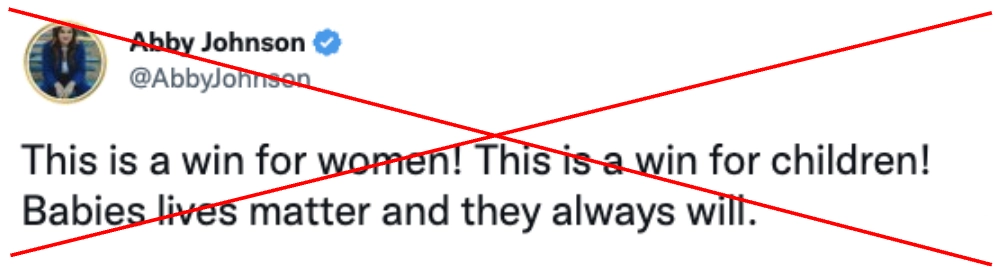
Screenshot of Twitter post from Abby Johnson crossed out with a large red X. The text reads: “This is a win for women! This is a win for children! Babies lives matter and they always will.”
After denying that their goal was to ban abortion care nationwide, anti-abortion politicians introduced a federal abortion ban that they outrageously billed as “moderate.” In September, Senator Lindsey Graham (R-SC) introduced a national ban on abortion that anti-abortion leaders framed as “compassionate” and the “least” Congress could do to “protectwomen.” Nonetheless, anti-abortion activists claimed the ban didn’t go far enough and called for legislation to lock ideological language into law defining when life begins and criminalize abortion, also known as “fetal personhood” measures.
Screenshot of Twitter post from Kristan Hawkins crossed out with a large red X. The text reads: “You think we’re stopping at 15-weeks? Ha… We have a surprise in store for you. #EndAbortion”
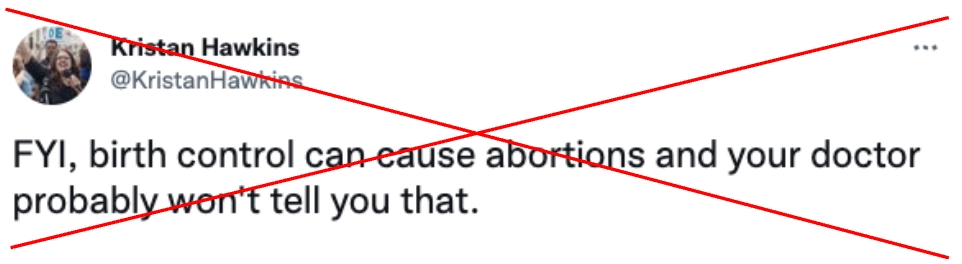
Anti-abortion leaders targeted birth control and IVF as part of their quest to roll back all our reproductive freedoms. The anti-abortion movement never intended to stop with ending Roe and ratcheted up its medicaldisinformation campaign againstcontraception and in vitro fertilization (IVF). Anti-abortion leaders fearmongered about the “risks” and “safety” of contraceptive care and falselyconflated it with abortion. Similarly, they perpetuated false narratives about IVF treatment by alleging that it was “unethical” and “practicing eugenics.” Anti-abortion politicians, including Georgia Governor Kemp and legislators in Tennessee, are already indicating support for restrictions on contraception and IVF.
Screenshot of Twitter post from Kristan Hawkins crossed out with a large red X. The text reads: “FYI, birth control can cause abortions and your doctor probably won’t tell you that”
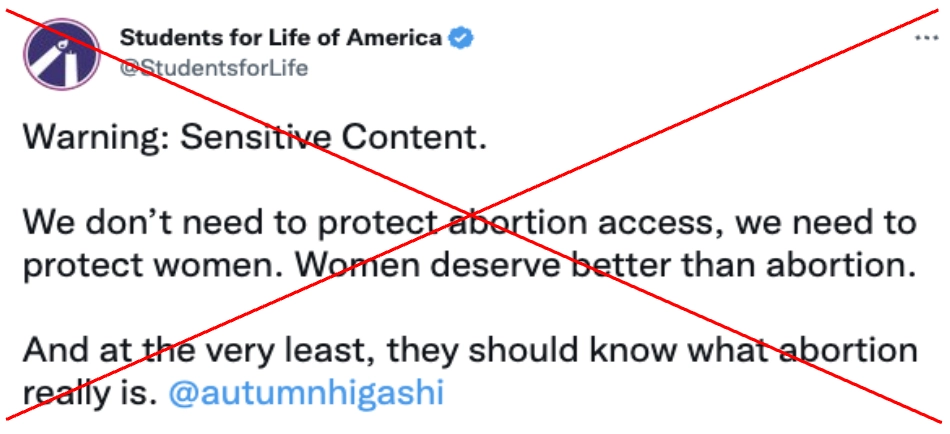
The anti-abortion movement’s fake feminism and commitment to “protecting women” was a smokescreen to conceal the dangers of anti-abortion policies. Under the guise of supporting “female empowerment” and “genderequality,” anti-abortion activists continuously attacked reproductive freedom. They purported to be advocates for and protectors of cisgender women while obscuring their regressive and harmful views of gender.
Screenshot of Twitter post from Students for Life crossed out with a large red X. The text reads: “Warning: Sensitive Content. We don’t need to protect abortion access, we need to protect women. Women deserve better than abortion. And at the very least, they should know what abortion really is. @autumnhigashi”
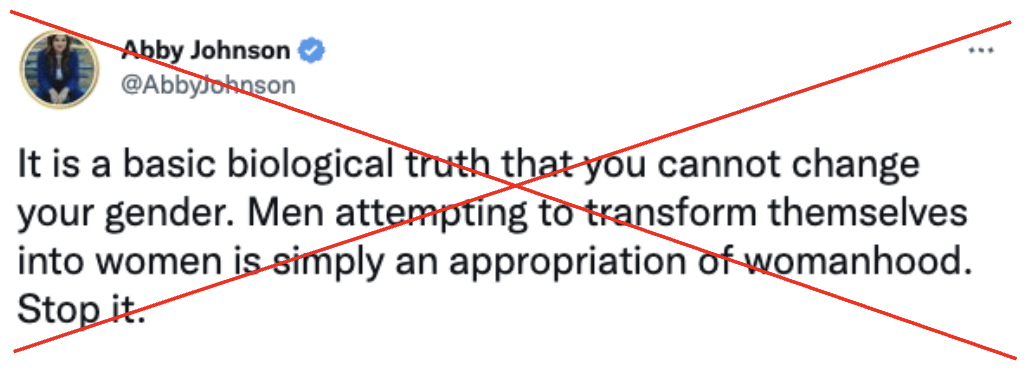
To further position itself as the defender of (cisgender) women and appeal to the ReligiousRight, the anti-abortion movement perpetuated transphobia and regressive views on gender. Anti-abortion activists claimed that gender inclusivity was an “appropriation” of womanhood. Their vehement support for anti-trans legislation and promotion of blatantly trans-exclusionary, gender-essentialist narratives underscored their dangerous and discriminatory objectives.
Screenshot of Twitter post from Abby Johnson crossed out with a large red X. The text reads: “It is a basic biological truth that you cannot change your gender. Men attempting to transform themselves into women is simply an appropriation of womanhood. Stop it.”
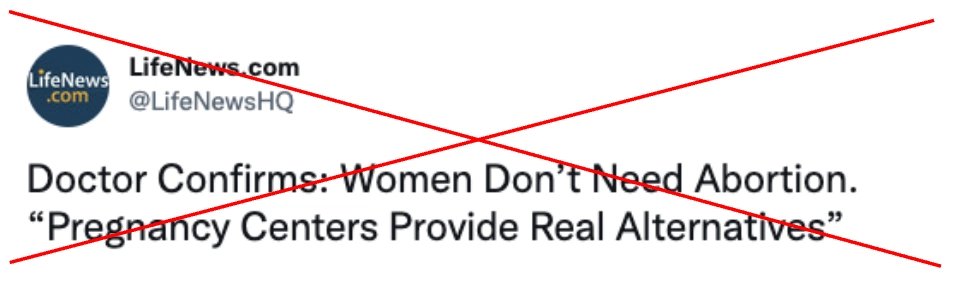
Anti-abortion actors defended their on-the-ground disinformation machines: fake health centers. The anti-abortion movement touted fake health centers as “alternatives to abortion,” falsely claiming that they “support” pregnant people. In practice, fake health centers—sometimes known as “crisis pregnancy centers”—notoriously use coercive messaging, medicaldisinformation about abortion care, and deceptivetactics to manipulate pregnant people’s decisions and attempt to block them from having an abortion.
Screenshot of Twitter post from Life News crossed out with a large red X. The text reads: “Doctor Confirms: Women Don’t Need Abortion. ‘Pregnancy Centers Provide Real Alternatives’”
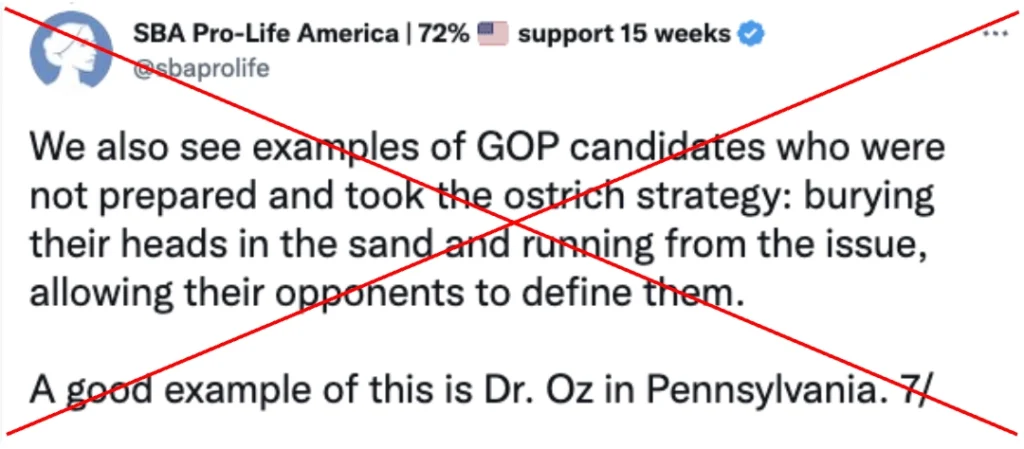
The anti-abortion movement sought to downplay its midterm electionlosses by misrepresenting public support for abortion. Anti-abortion politicians were purveyors of disinformation on the campaign trail and laidbare the movement’s patriarchal endgame of control over people’s decisions about if, when, and how to start or grow their families. To distract from strong voter opposition to its extremism and advance its anti-democracy agenda, anti-abortion activists argued that the midterm electionresults were fraudulent and the reproductive freedommovement “bought” the election.
Screenshot of Twitter post from SBA Pro-Life America crossed out with a large red X. The text reads: “We also see examples of GOP candidates who were not prepared and took the ostrich strategy: burying their heads in the sand and running from the issue, allowing their opponents to define them. A good example of this is Dr. Oz in Pennsylvania 7/”
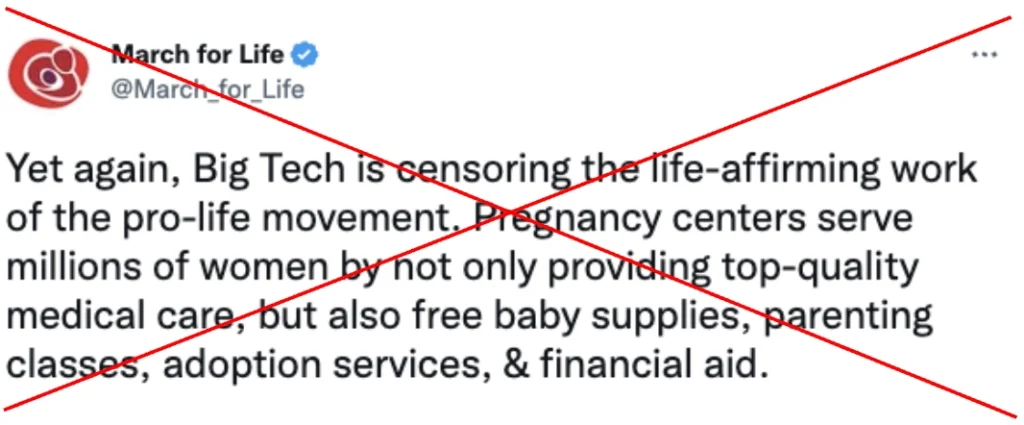
Finally, the anti-abortion movement made unfounded accusations of “censorship” from tech platforms when faced with disinformation accountability measures. Anti-abortion activists baselesslyclaimed content moderation constituted “discrimination” and “suppression” and doubled down on the falsenarrative that they are victims of “Big Tech.” In reality, their movement has thrived under lax internet policies that favor them. Despite these claims of suppression, platforms like Facebook and YouTube allow anti-abortion propaganda to spread, especially in Spanish-language media.
Screenshot of Twitter post from March for Life crossed out with a large red X. The text reads: “Yet again, Big Tech is censoring the life-affirming work of the pro-life movement. Pregnancy centers serve millions of women by not only providing top-quality medical care, but also free baby supplies, parenting classes, adoption services, & financial aid.”
Pushing Back on the Anti-Abortion Movement in 2023
The stakes for abortion rights and access are higher than ever in 2023, and the reproductive freedom movement must clearly define the villains who led us to this moment of crisis. Calling out the anti-abortion movement for its deceptive and cruel attacks on our fundamental rights is essential. In stark contrast with the anti-abortion movement’s extremist agenda, the reproductive freedom movement is working to build a world in which everybody is free to make the best decisions for themselves, their families, and their futures. In the new year, we must continue to combat anti-abortion disinformation and reclaim a narrative centered on pregnant people, medical consensus, and compassion when discussing reproductive care.