Join Our Volunteer Elections Team
We're pulling out all the stops to ensure voters get out and vote for reproductive freedom candidates up and down the ballot, and we want you with us!
Formerly NARAL Pro-Choice America
We advocate for our right to abortion, birth control, paid parental leave, protection from pregnancy discrimination, and so much more.
We're pulling out all the stops to ensure voters get out and vote for reproductive freedom candidates up and down the ballot, and we want you with us!
Equip yourself with the facts. Here you’ll find explainers, deep dives, and other resources on reproductive freedom.
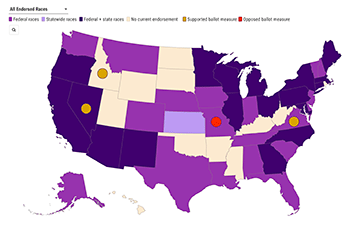
The key races we're invested in between now and November 3 to win back a reproductive freedom majority in the 2026 midterms.
Our electoral efforts connect voters with opportunities to make tangible change to help build a future where everyone is free to make their own decisions about their bodies, lives, and families.
We elect reproductive freedom champions from statehouses to the White House and protect and expand abortion rights and access through ballot measures.
Under a second Trump presidency, attacks on reproductive freedom have been relentless. But we’re tracking and fighting back against this extremist anti-abortion agenda.

Project 2025 is no longer just a “plan,” it’s a checklist of extreme policies being implemented at an alarming pace.
Mobilize your community. Hold lawmakers accountable. Organize for reproductive freedom!
Help turn values into votes by mobilizing voters and electing reproductive freedom champions up and down the ballot.
Activism 101 Deep Dives
So-called crisis pregnancy centers (CPCs) are not real health care clinics. Anti-abortion lawmakers use them to defend abortion bans and delay access to real care. Here’s how to spot them, and what you can do.
Key Takeaways
Look for these warning signs that indicate that you’re in an anti-abortion center:
Additional Resources:
Browse resources for accessing abortion care including abortion providers, information and advice, abortion funds, legal advocacy, and more.
Anti-abortion centers (AACs)—also called crisis pregnancy centers (CPCs)—are actually anti-abortion extremist organizations that lie, shame, and mislead patients.
Their goal: to stop people from accessing abortion and other forms of reproductive health care including birth control.
Anti-abortion lawmakers use anti-abortion centers to claim their “support” for pregnant people while also supporting abortion bans that cause irrevocable harm.
In reality, these “clinics” do not replace abortion care, or any type of comprehensive reproductive health care.
They are misinformation propaganda centers, funded by dark-money networks (as well as our tax dollars)—and they’re even used to mobilize for anti-abortion political campaigns.
Want to take action? Explore ways to get involved and fight anti-abortion extremism with us:
Here’s what anti-abortion extremists don’t tell you about these dangerous anti-abortion centers.
These centers disproportionately target young people, immigrants, uninsured patients, and communities of color—people who already face the greatest barriers to reproductive health care.
Unfortunately, these fake clinics are on the rise. Even in New York where abortion is legal and protected, anti-abortion centers outnumber abortion clinics, as reported by The New York Times in 2022.
Researchers identified more than 2,600 anti-abortion centers nationwide, compared with about 765 clinics that actually provide abortions—meaning fake clinics outnumber real providers more than three to one.
Most of these fake clinics do not provide:
Many anti-abortion centers collect personal health information even though they are not medical providers and may not be bound by the same HIPAA/privacy laws that protect patients at legitimate clinics.
This is a terrifying risk in our post-Dobbs world of surveillance and criminalization. In at least one documented case, an anti-abortion center shared client information with law enforcement in a pregnancy-related prosecution.
Those risks may only grow. President Trump told Time that he’d “let red states monitor women’s pregnancies and prosecute those who violate abortion bans“—a proposal aligned with Project 2025’s vision for expanding federal oversight of reproductive health in order to criminalize abortion.
These fake clinics are part of a well-funded national network of extremist groups including anti-abortion extremists such as Charlotte Lozier Institute, Heartbeat International, and Susan B. Anthony Pro-Life America.
Many operate under looser rules that allow them to:
One well-known tactic used by anti-abortion centers is exaggerating how far along someone is in their pregnancy. By intentionally misleading pregnant people to believe they are beyond the gestational limits of their local or neighboring states’ abortion bans, they cause delays in accessing legitimate, legal abortion care.
Fake clinics routinely blur the line between medical care and religious/ideological counseling. They might bring up prayer, scripture, or moral lectures that have no place in medical care unless you ask for them.
These fake clinics are supported by legal organizations such as anti-abortion extremist organization Alliance Defending Freedom, which has represented AACs in lawsuits opposing state oversight and disclosure requirements.
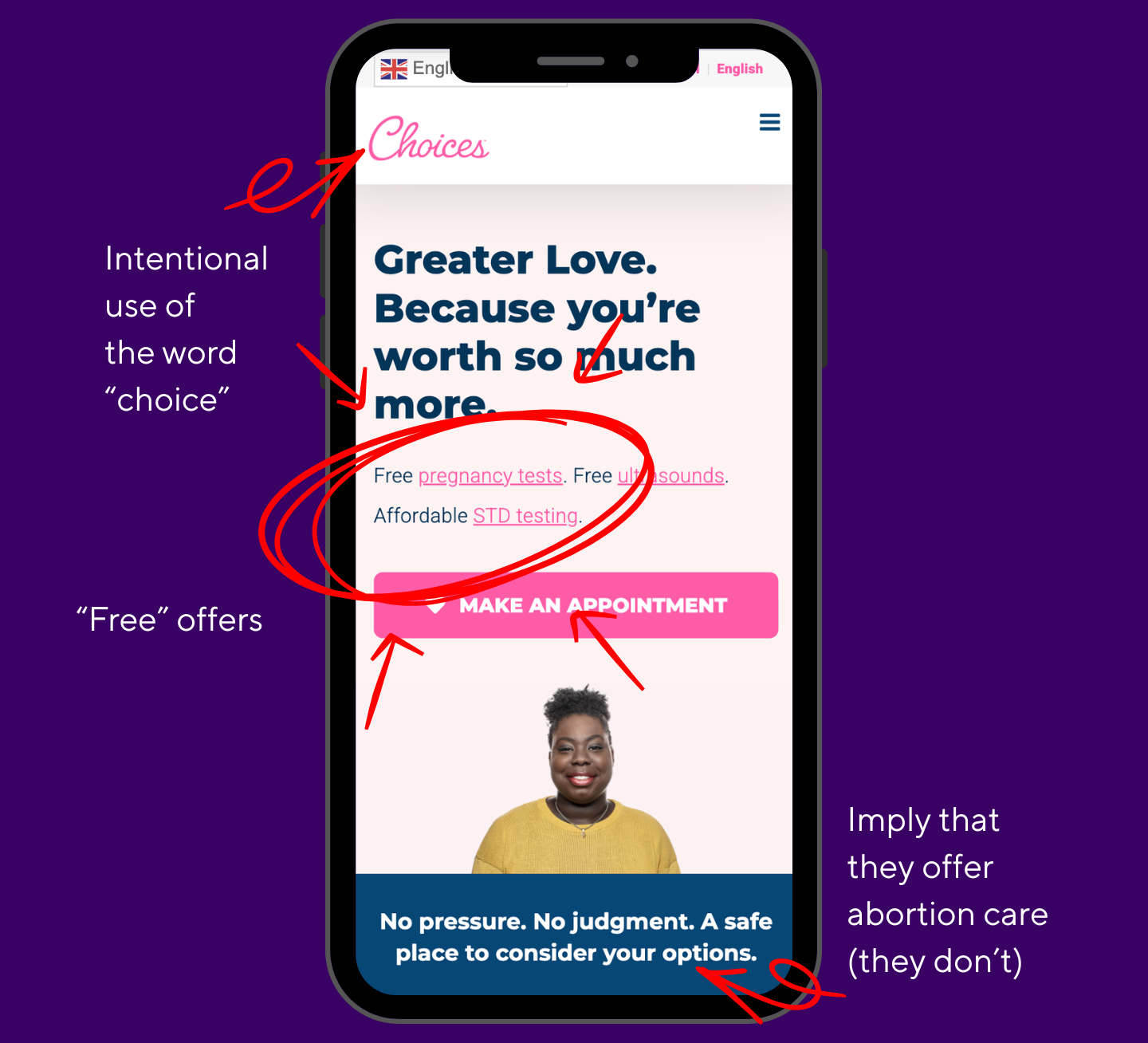
How Do People Stumble Into Fake Abortion Clinics?
Often, people seeking abortion care will find themselves in an AAC because of deceptive advertising practices.
Common tactics include:
Several states and cities have attempted to thwart these deceptive practices. For example, requiring anti-abortion centers to disclose that they do not provide abortion care, and that they are not licensed medical facilities.
But anti-abortion networks frequently challenge these rules in court. For example, Colorado recently faced a lawsuit by an anti-abortion center after the state tried to prevent AACs from performing risky, medically unsound treatments.
Anti-abortion centers and the organizations behind them have fought to avoid oversight in the courts. In the U.S. Supreme Court case First Choice Women’s Resource Centers v. Platkin, an unregulated crisis pregnancy center is challenging a state investigation into its advertising, medical claims, and privacy practices.
Meanwhile, Republican-led states are actively blocking attempts to regulate AACs. For example in 2025, Montana enacted a bill to prevent state and local governments from regulating anti-abortion centers, and this year Wyoming enacted a similar bill.
This is especially harmful in today’s abortion access landscape. For example, if a fake clinic exaggerates how far along someone is in their pregnancy in South Carolina, a person may believe they are no longer eligible for telehealth medication abortion—or that they no longer qualify for care in neighboring North Carolina—even though care may still have been available with accurate information.
AAC misinformation compounds existing barriers to abortion access. As a result, people may give up on care that was still legally available to them.
Diapers and baby clothes are often cited as proof of “support,” but they are not a substitute for reproductive health care or real economic support for families.
Many CPCs also advertise “free ultrasounds” to appear like legitimate medical clinics. A 2024 study published in JAMA found that 77% of anti-abortion centers advertise ultrasound services, even though many operate without licensed medical oversight.
In reality, these services are often used to delay care or persuade people not to seek abortion.
Abortion bans cause devastating harm, and fake clinics do nothing to mitigate it—they just add fuel to the fire.
Abortion bans lead to:
Yet instead of addressing these harms, anti-abortion lawmakers increasingly point to AACs as proof that pregnant people still have “support” and allocate our taxpayer dollars to fund them.
A recent report found that nearly $430 million in federal funding went to more than 650 anti-abortion centers between 2017 and 2023—often with little transparency or accountability, and despite mounting evidence of financial waste by AACs.
Lawmakers have funded AACs using federal funds meant to assist with basic needs for families experiencing poverty (the Temporary Assistance for Needy Families aka TANF program).
Punitive abortion bans have led to the preventable deaths of Amber Nicole Thurman, Candy Miller, and Tierra Walker.
Rather than address this crisis, lawmakers expanded funding for fake clinics, allocating $6 million taxpayer dollars to 95 anti-abortion centers through a grant program marketed as supporting “pregnancy resources” and through “Choose Life” license plate sales.
In Texas, where maternal and infant mortality has increased 56% since its abortion ban, lawmakers enacted a 2025 bill to create a tax credit for donations to anti-abortion centers.
In 2024, anti-abortion extremists used AACs for political mobilization against abortion access ballot initiatives, leveraging a nationwide network of 100,000 staff and volunteers and to funnel taxpayer dollars into their anti-abortion efforts.
Radical groups see these fake clinics as a cornerstone of their goal to “replace” Planned Parenthood and Title X programs and secure federal taxpayer funds to advance an agenda that “promotes childbirth and undermines evidence-based health care” as described in Project 2025.
Lawmakers cannot use AACs to claim their “support” for pregnant people while also supporting abortion bans that cause suffering and preventable deaths.
As abortion bans gut our reproductive health care, anti-abortion extremist lawmakers are increasingly promoting anti-abortion centers as the answer—even though these centers operate without the standards, accountability, or evidence-based care required of legitimate health clinics.
Anti-abortion centers are not a solution to abortion bans—if anything they cause more harm to pregnant people.
Everybody deserves timely, dignified medical care that is scientifically accurate, comprehensive, and unbiased. We need this in order to make personal decisions about our lives, our bodies, and our futures.
Need an abortion? There are resources available. Use our toolkit to spread the word about how to access abortion care, abortion funds, legal advocacy, and more.
Abortion is health care. Abortion is freedom. Share these resources with others to protect yourself and your community.
Charley is a secure chatbot that will provide immediate, accurate and up-to-date information about your abortion options—no matter where you live.

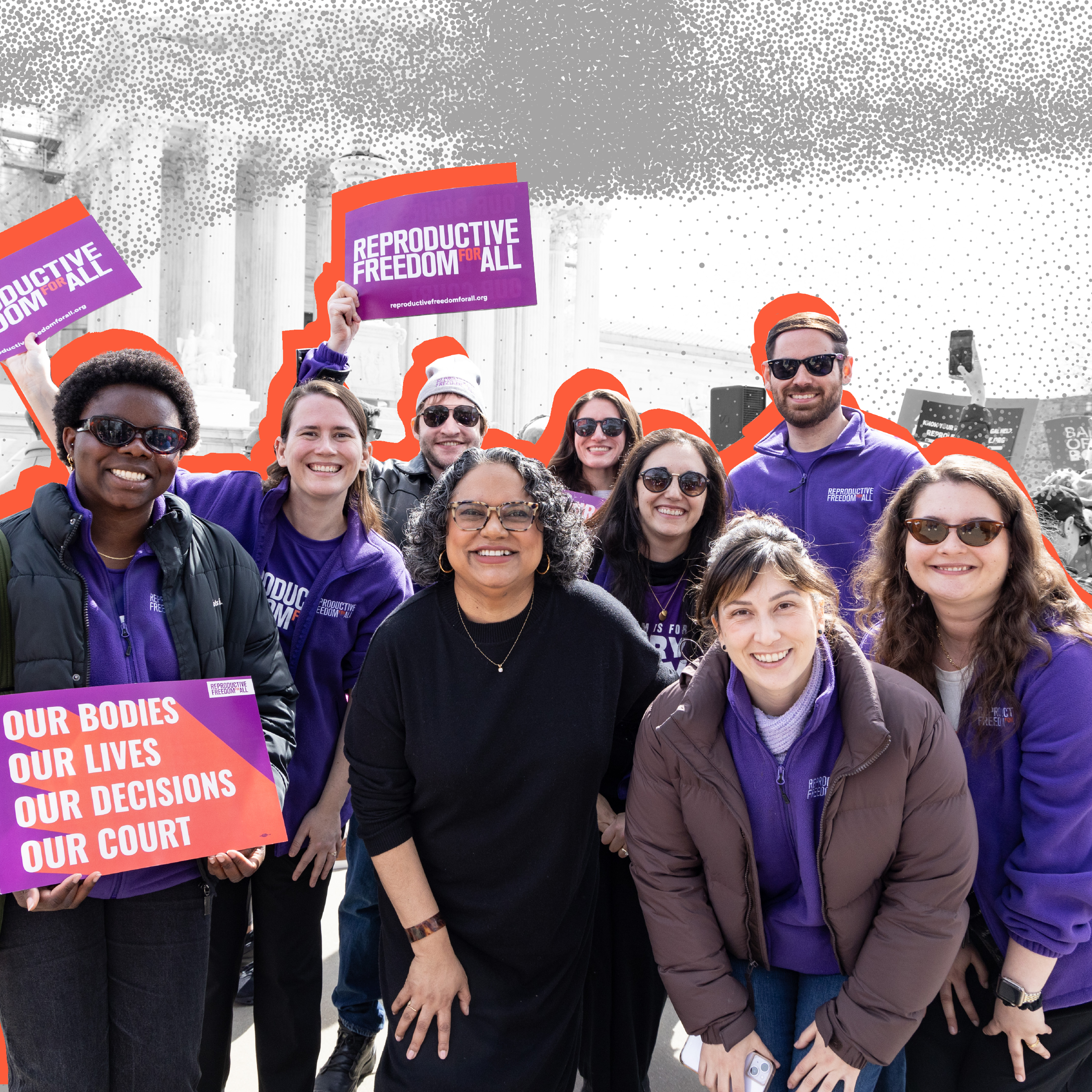
We Need You In This Fight
Reproductive Freedom for All mobilizes people to hold lawmakers accountable and fight against anti-abortion extremism.
Join us to fight abortion bans, stop the funding of fake clinics, and demand real care.
Podcast Reproductive Rights
Podcast Reproductive Rights
Deep Dives Reproductive Rights