Join Our Volunteer Elections Team
We're pulling out all the stops to ensure voters get out and vote for reproductive freedom candidates up and down the ballot, and we want you with us!
Formerly NARAL Pro-Choice America
We advocate for our right to abortion, birth control, paid parental leave, protection from pregnancy discrimination, and so much more.
We're pulling out all the stops to ensure voters get out and vote for reproductive freedom candidates up and down the ballot, and we want you with us!
Equip yourself with the facts. Here you’ll find explainers, deep dives, and other resources on reproductive freedom.
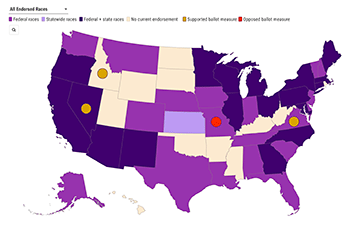
The key races we're invested in between now and November 3 to win back a reproductive freedom majority in the 2026 midterms.
Our electoral efforts connect voters with opportunities to make tangible change to help build a future where everyone is free to make their own decisions about their bodies, lives, and families.
We elect reproductive freedom champions from statehouses to the White House and protect and expand abortion rights and access through ballot measures.
Under a second Trump presidency, attacks on reproductive freedom have been relentless. But we’re tracking and fighting back against this extremist anti-abortion agenda.

Project 2025 is no longer just a “plan,” it’s a checklist of extreme policies being implemented at an alarming pace.
Mobilize your community. Hold lawmakers accountable. Organize for reproductive freedom!
Help turn values into votes by mobilizing voters and electing reproductive freedom champions up and down the ballot.
What's New at Repro for All Explainers
A volunteer story on changing your mind, growth, and showing up even when it’s hard.
From the desk of: Madisyn S. (she/her)
Volunteer, Reproductive Freedom for All
📣 Storytelling has and will always be a critical part of organizing; we can’t build community without it! Reproductive Freedom for All is building a team of storytellers—volunteers just like you—to amplify the message at the core of our work: that freedom is for everybody— and we want you with us.
Growing up in a small, Appalachian town in a red state, in a backward Pentecostal church and a school whose idea of sex education was graphic STI photos shown right before break, the me of 10 years ago never would have guessed that I’d be taking on leadership roles in activism spaces like Reproductive Freedom for All. Surrounded by negativity and lacking exposure to outside perspectives, I was pretty close-minded back then. I asked a lot of questions, and as most inquisitive young people can guess, most answers were “just because,” “I don’t know,” “you’re not supposed to know everything,” and other generally unsatisfying answers. But in 2016, I started doing my own research.
I was very active in my church’s youth group at the time, and with Kim Davis’ nonsense making gay marriage a hot topic for a few months, I figured a Bible study project would be a great solution to my latest questions and confusion. Using scripture and logic, I planned to debunk the top twelve arguments against Christianity, but I quickly found myself coming up with more questions than answers. My reasonings felt like a stretch, my verses were cherry-picked, and my “love the sinner, hate the sin” energy made me wonder if I was bending over backward to find truth in the narratives I’d grown up hearing from not only religious leaders, but family, friends, teachers, and my community at large.
Over the next few years, I read stories from oppressed groups and saw different folks represented in media I consumed. I interacted with people from all types of backgrounds, slowly expanding my worldview one step at a time. While I learned more about the world and outgrew the hatefulness of my hometown, continuing damage had been done in the realm of poor sex education and dated social norms for women. Consent, contraceptives, menstruation, STIs, and sexual attraction should have been basic things covered in my sex education, but their exclusion from my curriculum combined with the expectation for young women to “be nice” made me naive.
I was 18 when I entered my first relationship, but I was 21 when my roommates told me the sexual acts I endured in that relationship actually were sexual assault. At 19, during the summer I lost my virginity, I got three UTIs. I didn’t have any knowledge that ingredients in some colored condoms can cause UTIs until another woman shared her similar experience with me years later. At 20 years old, I wish I had known that menstrual cycles can fluctuate even while taking birth control; if I had, a barely late period wouldn’t have made me think that God was punishing me with an unplanned pregnancy for being sexually active. Just weeks before my 23rd birthday, I called a friend crying on the drive home from an assault to ask how long I had to wait to get STI tested and where I could go without my parents finding out.
To this day, I’m not sure which felt worse: the shame of filling out the forms in the health department or having to define “stealthing” when I told my friends what happened. This year, I’ll be 26 years old, yet I’m only recently discovering that I’ve been aromantic and asexual all along and that sex isn’t supposed to feel like something you’re supposed to do, a box to check off a to-do list, or a solution to boredom. Thanks for nothing, southern Ohio’s sex ed curriculum.
While my experiences led me to understanding, the start of my involvement in activism was more of a headfirst dive than a gradual process. Yes, my college years and early twenties were marked by me becoming an ally to minority groups, the token liberal and subsequent brunt of the joke at family gatherings with a desire to always learn more, but protesting and organizing felt like something I could never do. In 2022, I channeled my rage and horror at the Dobbs v. Jackson decision into art and attended my first Pride event in 2024, but I hadn’t taken any true steps toward making change. I was scared of ostracization from my community, terrified at the thought of being arrested, worried about backlash in the workplace, and clueless on where I’d even start if I could get the nerve to do so.
And then, the 2024 election happened, and everything changed.
When the opposing candidate wins an election, disappointment is normal. Frustration is common. Losing something is always a bit of a bummer. A nauseating sense of despair should not be normal, but that’s how millions of people in this country felt at the knowledge of what the next four years held in store, and I was no different.
In the months between the election and inauguration, my anxiety ate away at me, and doomscrolling occupied far too much of my time.
Eventually, the doomscrolling led me to a Ben and Jerry’s post about their toolkit for folks interested in getting involved, and I figured this was my chance. Through their site, I discovered organizations like Gender Liberation Movement, Women’s March, and Reproductive Freedom for All. When I attended a few meetings from each organization to try and find my place, I found it in Repro for All. I connected with people from my state as well as leaders who patiently answered all of my questions and supported me as a baby activist. I was finally able to find a way to start changing the world around me one step at a time.
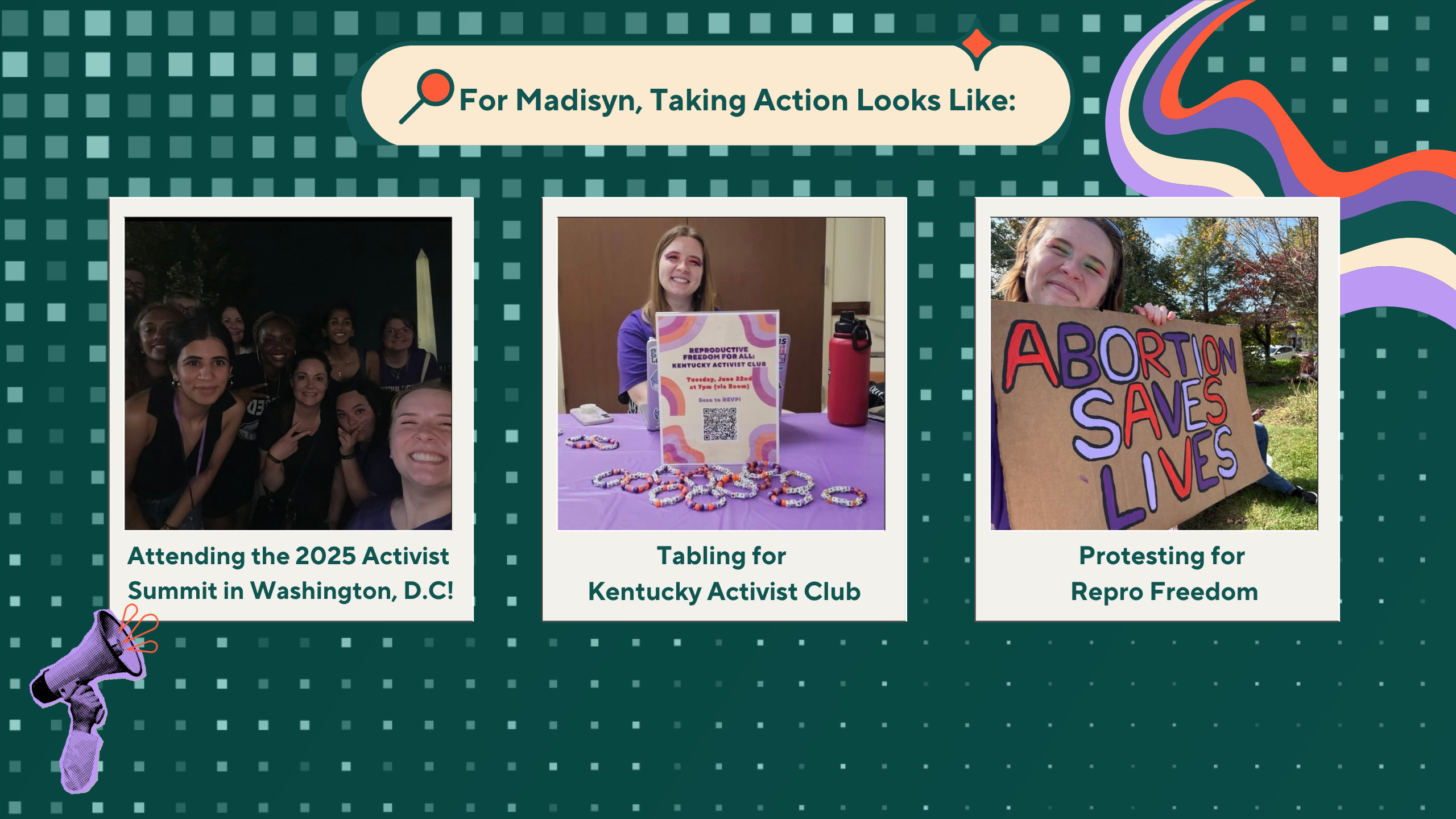
In just over a year, I’ve become a leader within Repro for All’s National Youth Action Council, attended an Activist Summit in our nation’s capital, shared my (much condensed) story to Capitol Hill staff, started my own Kentucky Activist Club to bring attention to an often ignored state, spoke at a protest despite public speaking being my absolute nightmare, and connected with other Kentucky organizations to educate and mobilize Kentuckians in the fight for reproductive freedom.
If I could give one piece of advice to anyone who wants to get involved, but is scared to start and doesn’t know how, it would be this: every action, every step, and every person counts.
I’ve hosted many meetings where it’s just me, my organizing leader, and two friends, but those friends know and meet other folks, share their newfound knowledge, and every one of those conversations counts. I have some weeks where I don’t have capacity to turn on my camera, let alone take on any new leadership roles, but showing your support and willingness to learn by just attending a meeting counts. Writing a single letter to your representative counts. Inviting a friend to an event counts. I grew up always so concerned with how I, as an individual, can change the world, but I’ve learned that the best place to start is by simply changing my world.
It’s never too late to start, and your impact is never too small.
Reading and seeing the news can be traumatic right now. It can make you feel like nothing can be done because the world is going in a direction you hate. Social media and the news can be so discouraging.
But at the same time, there are so many gains we’re making across the states.
People are coming together and speaking out at rallies, getting involved in tabling events, and spreading the news on social media.
It might be hard to see where you fit in between all of it, but there are many ways to make it more personal to you. You can join in-person and virtual events, work in apps like Impactive, or participate in text and call campaigns. You can even host your own events at your school or a Rights Night in your living room. It doesn’t have to be a big, grand gesture; the smallest things help.
Join me in the fight for reproductive freedom today!
Storytelling is crucial to pushing the reproductive freedom movement forward. Help strengthen the movement when you share your story.
One of the most effective ways to help people understand reproductive freedom is one-on-one conversations.
We're pulling out all the stops to ensure voters get out and vote for reproductive freedom candidates up and down the ballot, and we need your help to make it happen!
Podcast Reproductive Rights
Podcast Reproductive Rights
Podcast Reproductive Rights

Get Involved
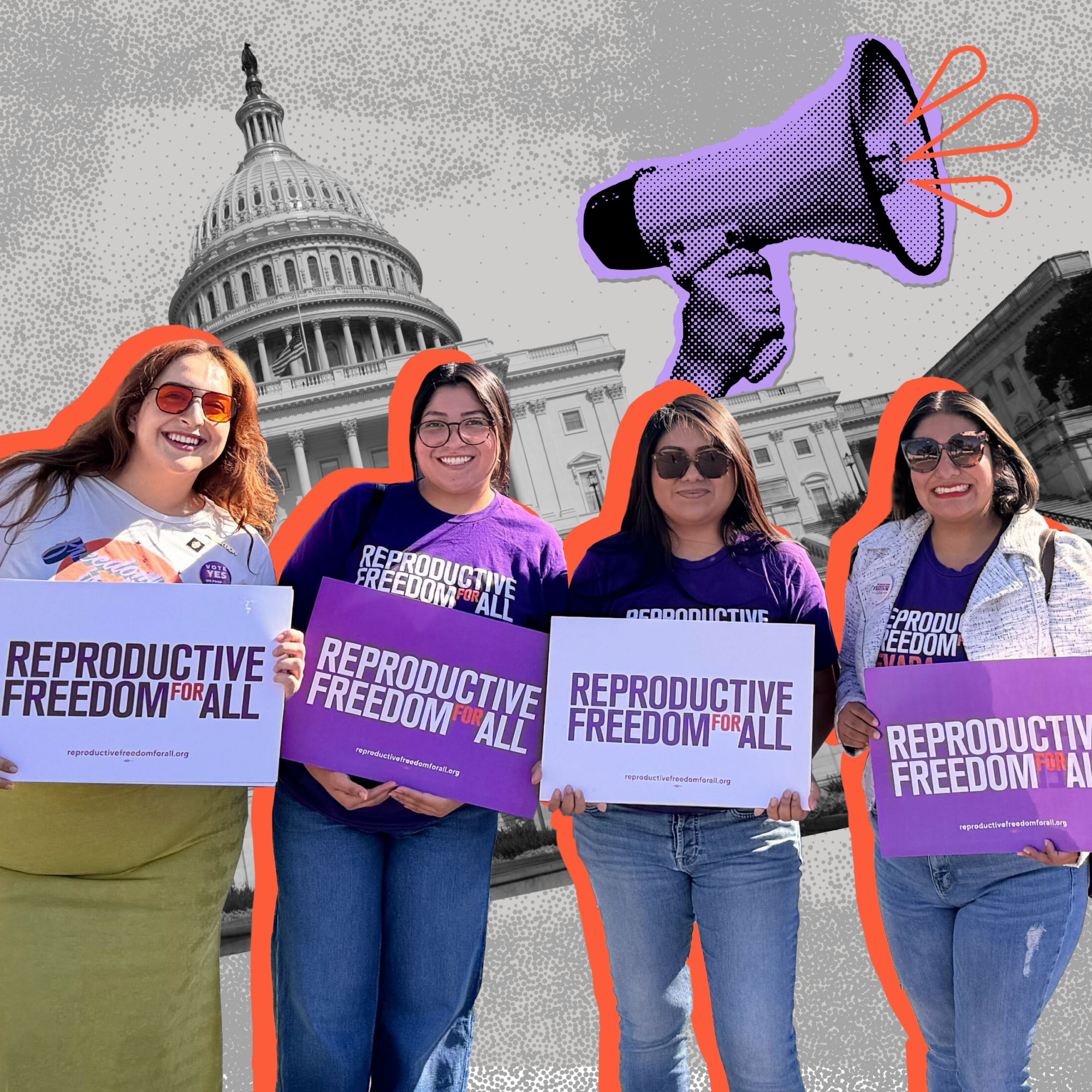
Reproductive Freedom for All is made up of members across the country who believe that everybody should be free to control their own bodies and lives—and we want you to be a part of it.
Subscribe to be one of the first to receive updates on the state of reproductive freedom and opportunities to take action.