
Join Our Volunteer Elections Team
We're pulling out all the stops to ensure voters get out and vote for reproductive freedom candidates up and down the ballot, and we want you with us!
Formerly NARAL Pro-Choice America
We advocate for our right to abortion, birth control, paid parental leave, protection from pregnancy discrimination, and so much more.
We're pulling out all the stops to ensure voters get out and vote for reproductive freedom candidates up and down the ballot, and we want you with us!
Equip yourself with the facts. Here you’ll find explainers, deep dives, and other resources on reproductive freedom.
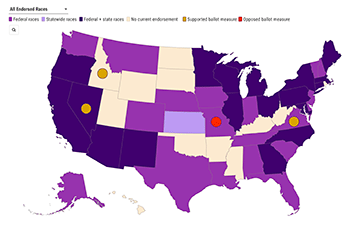
The key races we're invested in between now and November 3 to win back a reproductive freedom majority in the 2026 midterms.
Our electoral efforts connect voters with opportunities to make tangible change to help build a future where everyone is free to make their own decisions about their bodies, lives, and families.
We elect reproductive freedom champions from statehouses to the White House and protect and expand abortion rights and access through ballot measures.
Under a second Trump presidency, attacks on reproductive freedom have been relentless. But we’re tracking and fighting back against this extremist anti-abortion agenda.

Project 2025 is no longer just a “plan,” it’s a checklist of extreme policies being implemented at an alarming pace.
Mobilize your community. Hold lawmakers accountable. Organize for reproductive freedom!
Help turn values into votes by mobilizing voters and electing reproductive freedom champions up and down the ballot.
Activism 101 Toplines
Changing what abortion is called does not fix the harm caused by bans
In some states, they are rewriting abortion laws to say that care for a miscarriage or ectopic pregnancy is not abortion. In others, they are targeting the words that appear in a patient’s medical records.
The antis often describe these bills as “clarifications.” But the real problem is not that abortion bans need better wording. The problem is the bans.
Abortion bans have led to irreparable harm, including tragic and preventable deaths. Patients have been denied care or forced to wait while their health gets worse.
Instead of repealing the laws that caused this crisis, some lawmakers are drawing new lines around which care they consider “acceptable” abortion care.
Changing the label does not change the underlying threat to our health and freedom.
Here’s how this pattern can look:
Redefining abortion is a shallow attempt for anti-abortion lawmakers to claim they have solved the problem. At the same time, their harmful bans remain in place.
As of July 2026, this strategy has appeared in several states.
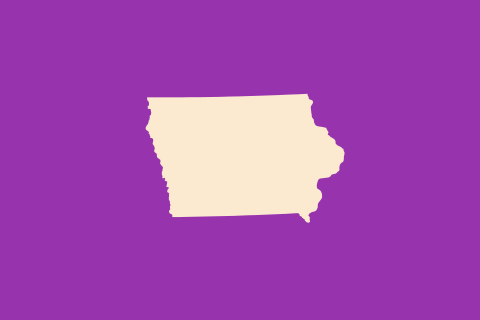
HF 2788
changed the state’s definition of abortion to exclude miscarriage management and ectopic pregnancies.
The same law also imposed new restrictions on medication abortion—a safe, effective, method that accounts for more than half of all abortion care nationwide.

HB 288
requires that the word “miscarriage” immediately follow in parentheses whenever the term “spontaneous abortion” is used in medical documentation.

HB 1257
changed the state law’s definition of abortion to exclude miscarriage care, ectopic pregnancy treatment, and other pregnancy-related care.
Lawmakers also introduced related proposals in South Carolina (H 4130) , Utah (HB 480), and Wisconsin (AB 546).
The details differ, but the strategy is similar: separate certain pregnancy-related care from abortion through legal definitions or medical documentation while leaving broader abortion restrictions in place.
A KFF review of exceptions in state abortion bans found that health and life exceptions have often been unworkable in most circumstances. Vague, narrow, and nonmedical language can leave providers unsure of when they are legally allowed to act.
And—even new “clarifications” may not eliminate a climate of fear.
In 2026, The Texas Tribune reported on a patient who was denied her miscarriage care at two hospitals after Texas passed a law intended to give providers more clarity. She said she developed an infection before finally receiving treatment from her doctor.
No one should have to become sicker before getting the care they need.
They can involve the same providers, medications, procedures, and patients. As the Guttmacher Institute explains, trying to create a false divide between them can harm patients and further restrict reproductive health care.
They suggest that some patients deserve care only if politicians can call that care something other than abortion. Meanwhile, people who need or want abortion care remain targets of bans and political attacks.
It's going to take all of us to win back our freedom. Add your name today to commit to fighting for reproductive freedom.
Need an abortion? There are resources available. Use our toolkit to spread the word about how to access abortion care, abortion funds, legal advocacy, and more.
Your state lawmakers have the power to pass legislation that will shape our daily lives. Let them know you support reproductive freedom, and you're paying attention.
Explainers Reproductive Rights
Deep Dives Activism 101
Toplines Activism 101